Visalia, Tulare & Kings County, CA
Septic tank pumping in Visalia, Tulare & Kings County
What a pump-out actually costs, how often you really need one, and free matching with an independent, county-registered pumper — no obligation to hire anyone.
Serving rural and unincorporated properties around Visalia, Tulare, Hanford, Exeter, Porterville and Dinuba — the Tulare and Kings County septic country.
A different trade than repair
Pumping is county-registered, not CSLB-licensed.
That's normal, not a red flag. A pumper who finds a real problem — a crack, a failed baffle, a saturated drain field — hands you off to CSLB C-42 contractor work instead.
As of 2026-09, septic tank pumping near Visalia, CA typically costs $213–$855, with a standard residential tank most often landing around $350–$650.
Visalia Septic Pro — Get free quotes
What septic pumping costs near Visalia
Two sourced ranges, shown separately rather than blended into one number: what Visalia-area customers actually report paying, and a regional standard-tank figure for comparison.
| Job | Typical cost | Source |
|---|---|---|
| Visalia-area typical range (all pump-outs) | $213–$855 | Visalia homeyou.com, Visalia CA aggregator (281 Visalia septic-tank-cleaning quotes, read Jul 2026) |
| Standard 1,000–1,250 gal tank, 3–4 bed home | $350–$650 | California Sierra Sanitation, Central Valley regional guide, 1,000–1,250 gal tank / 3–4 bed home (published Mar 2026) |
| Basic dumping (easy access) | $70–$200 | Visalia can reach $400+ for harder access |
| Larger tank (1,500–2,500 gal) | $200–$400 | Visalia homeyou.com, Visalia CA — 1,500–2,500 gallon tanks (read Jul 2026) |
| Effluent filter cleaning/install | $200–$300 | Visalia homeyou.com, Visalia CA (read Jul 2026) |
| Buried-lid uncovering / dig fee | $50–$150 | California added on top of the pump-out itself |
| Soil fracturing (only if needed) | $1,000–$2,500 | Visalia Only needed when compacted soil is blocking drainage — not a routine pumping cost. |
Full sourcing and methodology: septic cost guide — Visalia. Neglecting a pump-out doesn't just risk a bigger bill later — Sierra Sanitation puts a fully failed system at $10,000–$20,000 to replace.
Is it time to pump your tank?
- 1
It has simply been 3 to 5 years
Tulare County Environmental Health’s own guidance: pump every 3–5 years for an average household, more often with heavy use, a garbage disposal, or a smaller tank.
- 2
Drains are slow or gurgle across the whole house
One slow drain is usually a local clog. Multiple slow or gurgling drains at once points toward a full tank or a developing drain-field problem — either way, a pump-out is the fastest way to find out which.
- 3
Standing water or a spongy patch over the drain field
Wet ground over the leach lines, especially after dry weather, suggests the field is getting more liquid than it can absorb — a full tank is the most common, and most fixable, cause.
- 4
A sewage smell near the tank or drain field
An odor outdoors near the tank lids or drain field, as opposed to inside the house, often means gases are escaping past a full tank or a failing seal.
- 5
You don’t know when it was last pumped
Buying a home, or simply inheriting a septic system with no maintenance record, is itself a reason to schedule a pump-out and inspection rather than guess.
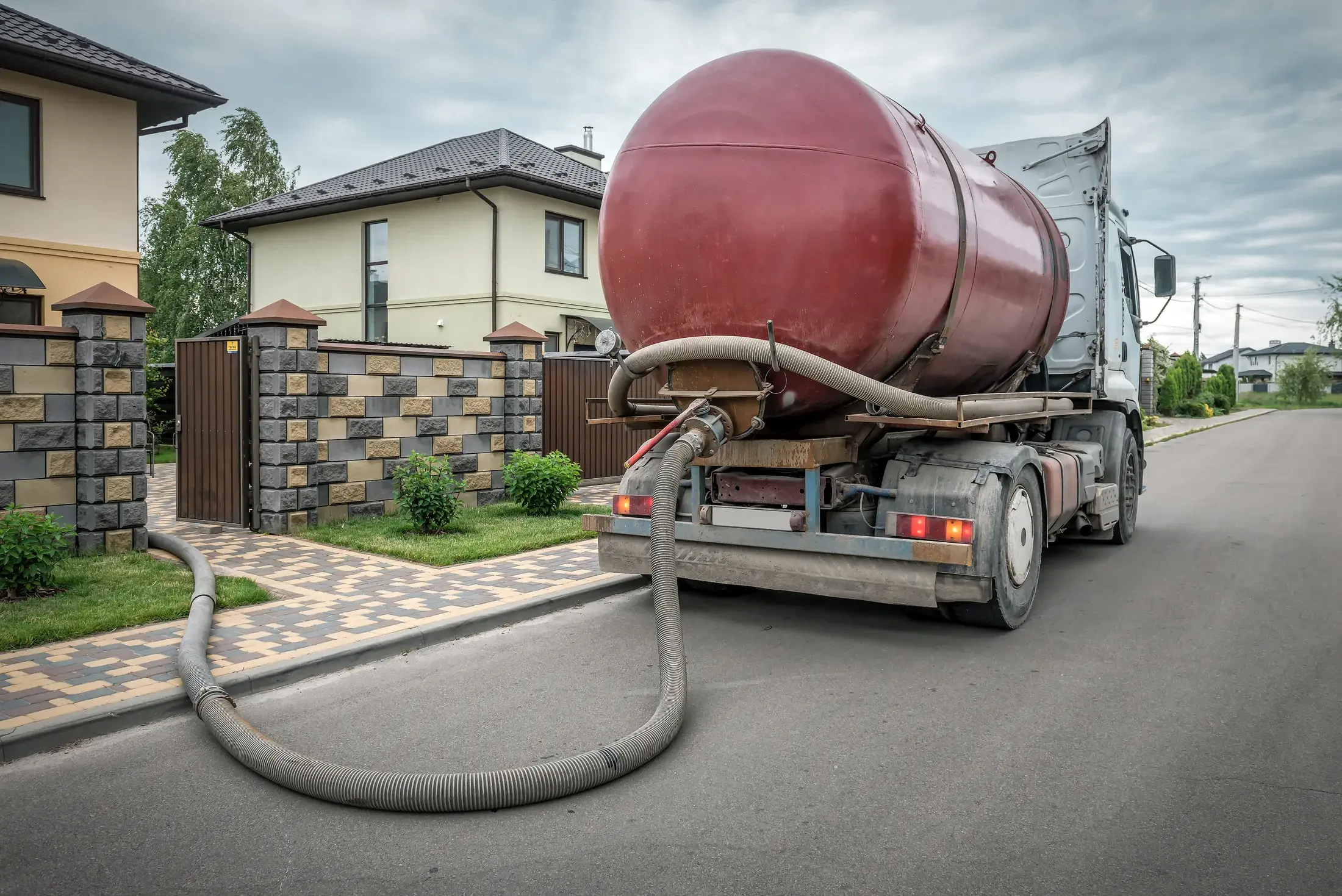
What a pump-out actually checks
Vacuuming the tank is the obvious part, but a pump-out is also the cheapest look inside your system you'll ever get. An attentive operator checks the inlet and outlet baffles for cracks or corrosion, notes how thick the sludge and scum layers are relative to the tank's rated size, and watches whether the effluent level drops normally or whether liquid keeps backing up from the drain-field side — an early warning a leach field is saturated well before it surfaces as standing water in the yard.
None of that is CSLB-licensed diagnostic work — it's part of what a competent county-registered pumper does as a matter of course. But if what they find points to a cracked tank, a failed baffle, or a drain field that isn't absorbing liquid the way it should, that's the point where the job stops being a pumping job and becomes CSLB C-42 contractor work. A straight pumping company should tell you this rather than attempt a repair itself — see our septic repair & emergency backup guide for what typically happens next, and how we match septic pros for how the two trades split under California law.
Rural and unincorporated properties around Tulare, Hanford, Exeter, Porterville, Dinuba are where most of this portfolio's septic demand concentrates — city-sewer Visalia neighborhoods mostly aren't on tanks at all. If you're on a well and a tank rather than city water and sewer, the guidance on this page applies to you regardless of which side of the Tulare/Kings county line your property sits on.
FAQ
Septic pumping questions Visalia homeowners ask
How much does septic pumping cost near Visalia, CA in 2026?
Local pricing reported by Visalia-area customers runs $213–$855 for a typical pump-out, with a standard 1,000–1,250 gallon residential tank most often landing in the $350–$650 range. The wider local figure includes jobs that need extra work like soil fracturing; a routine pump-out with easy access sits toward the lower end. See our full cost guide for the breakdown by job type.
Does a septic pumping company need a California contractor license?
No. Septic pumping and hauling is regulated as a separate, county-level trade, not a CSLB contractor classification — a pumping-only company will legitimately never show up in a CSLB license search, and that is not a red flag. It is a different rule from septic installation, repair, or replacement, which does require a CSLB C-42 Sanitation System Contractor license. See how we match septic pros for the full split.
How often should a septic tank actually be pumped?
Every 3 to 5 years for an average household, per Tulare County Environmental Health’s own guidance — more often with heavy household use, a garbage disposal, a smaller tank, or more people living in the home than the system was designed for.
What happens during a pump-out?
A pumper truck vacuums out the tank’s contents through the access lid, which typically takes 45 to 90 minutes for a standard residential tank. A conscientious operator also looks at the baffles, the sludge and scum layer thickness, and whether liquid is flowing back from the drain field — early signs of a bigger problem than a full tank.
What if the pumper finds something wrong beyond a full tank?
A cracked tank, a failed baffle, or a saturated drain field is CSLB C-42 contractor work, not pumping work — a straight pump-out company will tell you to get a licensed contractor out, not attempt the repair itself. See our septic repair & emergency backup guide for what happens next.
Can I find my tank’s access lids myself before the pumper arrives?
If you have a system diagram or remember roughly where the tank sits (often 10–25 feet from the house, in line with the main sewer line out), a rod or probe can help locate the lids and save excavation time — this is optional, and a pumper can locate the tank without it, sometimes for the additional fee noted above.
Get free quotes
Request pump-out quotes
Tell us your tank's rough age, size if you know it, and what's prompting the call. An independent, county-registered pumper serving your area follows up — no cost, no obligation.
- Cost to you: $0
- Coverage: Tulare and Kings County septic properties
This form isn't connected yet — lead routing is built in Phase 8/9 of the build plan. Nothing you type here is sent anywhere. It's shown to confirm layout, validation and the anchor the header and sticky-bar quote buttons point to.